
TL;DR: Cross-chain intents let users specify the outcome they want (e.g., "move my USDC from Arbitrum to Base") instead of manually navigating bridges, routes, and execution steps. A network of specialized actors called solvers competes to fulfill those requests, often delivering results before final settlement completes.
When you swap tokens across chains in a DeFi app, you probably don't think much about what's happening underneath. You enter an amount, confirm a transaction, and assets arrive on the destination chain. That seamless experience is largely made possible by cross-chain intents.
Cross-chain intents are the infrastructure running behind many of the cross-chain interactions users take for granted today (it wasn’t always so easy!). Instead of requiring apps or users to manually coordinate bridges, routes, and execution steps, intent-based systems let users specify the outcome they want and hand execution off to a competitive network of specialized actors called solvers.
This guide covers how cross-chain intents work, why they matter for users and builders, and examples of where they show up in today's crypto landscape.
What Are Cross-Chain Intents?
A cross-chain intent is an order where a user specifies the desired outcome rather than the execution steps. Instead of manually choosing a bridge, selecting a route, waiting for finality, and then executing a follow-up action, the user describes the result they want the system to produce.
That result can be simple, such as "move my USDC from Arbitrum to Base," or more expressive, such as bridging USDC to Ethereum and depositing it into Aave. It can also include a swap, as in trading ETH on one chain for USDC on another chain with a minimum acceptable output.
The key distinction is that the user defines the destination state, not the path. The system's job is then to find a way to satisfy that request within the constraints the user sets.
How Cross-Chain Intents Work
Implementations differ, but many systems follow the same basic flow.
1. The User Expresses the Desired Outcome
An intent starts with a request that defines acceptable parameters for an outcome. The request often includes the input asset, the output asset, the source and destination chains, the recipient, the minimum acceptable output, and sometimes an additional action to perform after funds arrive.
2. Solvers Compete to Fulfill the Intent
Once the intent is created, specialized third parties, known as solvers (sometimes called fillers or resolvers, among other terms), compete to execute it. Solvers use their own capital, liquidity access, routing logic, and infrastructure to deliver the requested result and receive a reward for doing so.
That competitive model appears across other intent-based protocols. UniswapX uses signed offchain orders that fillers compete to satisfy, while 1inch Fusion relies on resolvers that fill orders and pay the associated gas fees. Execution quality depends on a competitive marketplace instead of a single static route.
Competition can improve pricing and reduce friction while shifting operational complexity to professional execution actors who handle routing and settlement.
3. The Solver Delivers the Outcome
Once a solver wins the order, it executes on the user's behalf, sourcing liquidity, routing across chains, and settling the transaction. The user receives the requested asset on the destination chain without having to manage any of the steps in between.
Cross-Chain Intents vs. Traditional Bridges
Traditional bridges and intent-based systems are both trying to move value or instructions across chains, but they put the burden in different places.
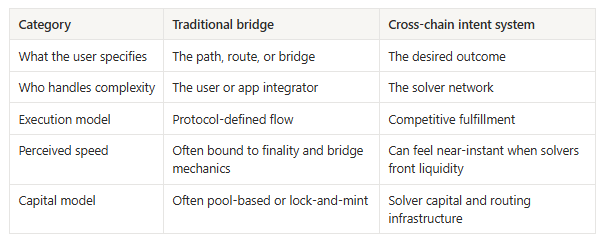
Intents do not replace every bridge design, but they change the interface. Traditional bridging asks the user to think in terms of rails; intents ask the user to think in terms of outcomes.
Why Cross-Chain Intents Matter
The benefit of intents centers on abstraction for the end user.
Better UX for Users
Users no longer need to understand the full machinery under the hood. A person trying to move assets across chains usually cares about getting the right asset to the right destination quickly and safely. Intent-based systems reduce the number of manual decisions required to get there.
That makes cross-chain activity feel like using an application instead of managing infrastructure. Fewer steps also mean fewer chances for confusion or failure.
Better Abstraction for Developers
Intents give developers a cleaner application layer. Instead of integrating multiple bridges and custom routing logic just to support a common user journey, teams can target an outcome-based execution model. It’s similar to how a single API call handles the complexity of a task.
That abstraction becomes more useful as user actions get more complex, since swapping on one chain and depositing on another is easier to express as a single desired result than as a chain of manual operations.
Better Market Competition Around Execution
Cross-chain intents also change the market structure behind execution. Because solvers compete for orders, they have an incentive to improve routing, source liquidity efficiently, and manage risk well. UniswapX, for example, explicitly uses auction-based filler competition to improve prices, reduce failed transaction costs, and protect users from extractive execution patterns.
This does not guarantee the best outcome every time, but it lets execution quality improve through competition rather than a hardcoded route.
Where Cross-Chain Intents Are Already Showing Up
Cross-chain intents are actively powering the UX of modern crypto applications. Instead of asking users to manage multi-step bridge-and-swap flows, builders are using intents to abstract the underlying infrastructure entirely.
- Unified DeFi Liquidity: Users can deposit collateral on one chain (like Ethereum) and seamlessly borrow against it or farm yields on an L2 (like Base or Optimism), maximizing capital efficiency without manual bridging.
- One-Click Actions Across Chains: An intent can allow a user with a USDC balance on Arbitrum to instantly pay for and mint an NFT on another chain like Base in a single transaction. Solvers handle the bridge, swap, and mint execution in the background.
- Cross-Chain Governance: DAOs can allow token holders to vote on low-fee networks like Arbitrum while executing the final governance decisions and treasury movements on Ethereum mainnet.
- Abstracted Wallet Experiences: Wallets and aggregators are increasingly allowing users to hold assets on any chain while interacting with dApps anywhere else. A user can manage a single balance that acts as their key to trading or depositing across the entire ecosystem.
Instead of thinking about chains as separate environments, users are finally able to just use applications while solvers and intent networks coordinate the heavy lifting on the backend.
Risks, Tradeoffs, and Design Challenges
Cross-chain intents improve the interface but do not eliminate risk. They move complexity behind it.
Solver Availability and Marketplace Health
An intent system is only as strong as the network willing to fill orders. If there are too few capable solvers, users may face worse pricing, slower execution, or failed fulfillment.
Security Assumptions and Failure Modes
Intent systems still depend on bridge logic, settlement contracts, message passing, and the behavior of third-party executors.
Trust, Settlement, and Finality Risk
Fast fulfillment often works because a solver is willing to front capital before final settlement. This introduces a risk transfer. The solver must price the possibility that settlement is delayed, fails, or becomes more expensive than expected.
Pricing Transparency and Slippage Protection
Intent-based UX can be cleaner than manual routing, but users still need clear guarantees around minimum output, fees, and timing. When systems claim better pricing or lower friction, the practical question is whether those gains are consistently visible to the user and protected by enforceable parameters.
Conclusion
Cross-chain intents matter because they change the unit of interaction. Instead of telling infrastructure exactly how to move through a fragmented multi-chain world, users describe the state they want to reach.
That shift can make cross-chain applications easier to use and simpler to integrate while creating competition around execution quality, since professional solvers compete on speed, liquidity, and routing.
Standardization, security, solver marketplace depth, and transparency are still open problems, but cross-chain intents offer a practical model for simplifying the multi-chain user experience.
FAQs
What Is a Cross-Chain Intent?
A cross-chain intent is an order where the user defines the desired outcome instead of manually specifying each bridge, route, and execution step. The system then relies on specialized executors to satisfy that request.
How Is a Cross-Chain Intent Different from a Traditional Bridge?
A traditional bridge usually asks the user to choose the path and wait through the protocol's flow. An intent-based system asks the user to define the result, then lets solvers compete to deliver it.
What Is a Solver in a Cross-Chain Intent System?
A solver is a specialized execution participant that uses capital, liquidity access, and routing logic to fulfill intents. Depending on the protocol, this role may also be called a filler, resolver, or relayer.
Are Cross-Chain Intents Always Faster?
Not automatically, but they can feel much faster to the user because some systems allow solvers to fulfill the requested outcome before final settlement completes. That improves perceived speed even when backend finality still takes time.
What Is ERC-7683?
ERC-7683 is the standard for cross-chain intents on Ethereum, adopted by 70+ protocols. It defines a common structure for how cross-chain orders are expressed and how settlement interfaces work, enabling shared filler infrastructure across protocols without prescribing a single implementation.
Do Cross-Chain Intents Remove Risk?
No. They simplify the user experience, but the system still depends on settlement design, security assumptions, solver availability, and transparent execution guarantees.
Why Do Cross-Chain Intents Matter for Builders?
They give builders a cleaner abstraction for multi-chain actions. Instead of forcing users through a chain of separate bridge and swap flows, applications can target one requested outcome and rely on execution infrastructure to handle the rest.


